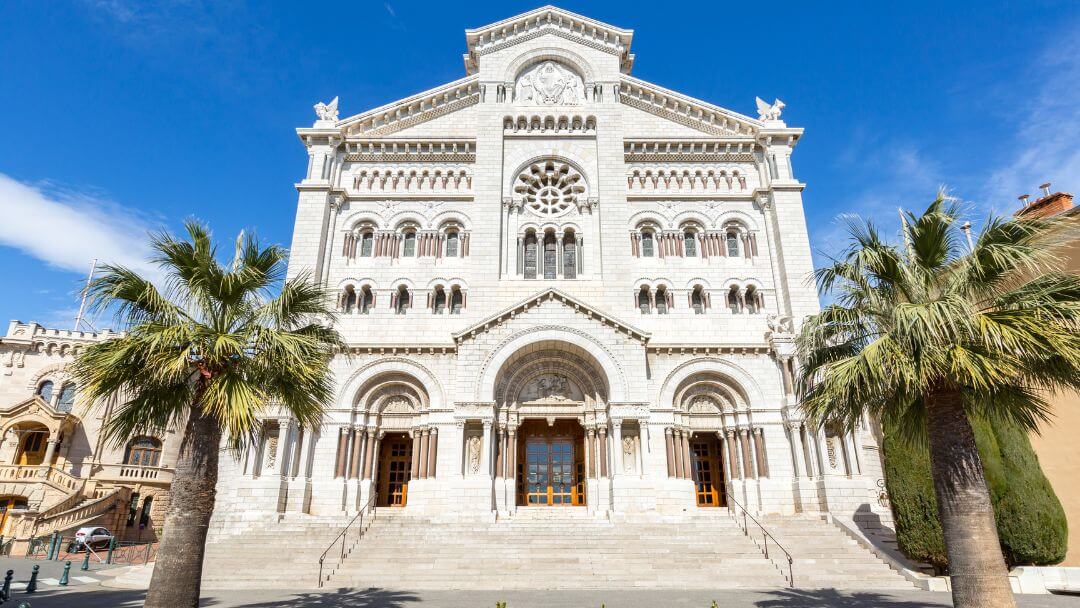
In the heart of the Rock, the Saint-Nicolas Cathedral in Monaco is a must-see attraction. With Tour Azur, a tour and transfer operator on the French Riviera, discover the history, secrets, and practical information about this iconic landmark.
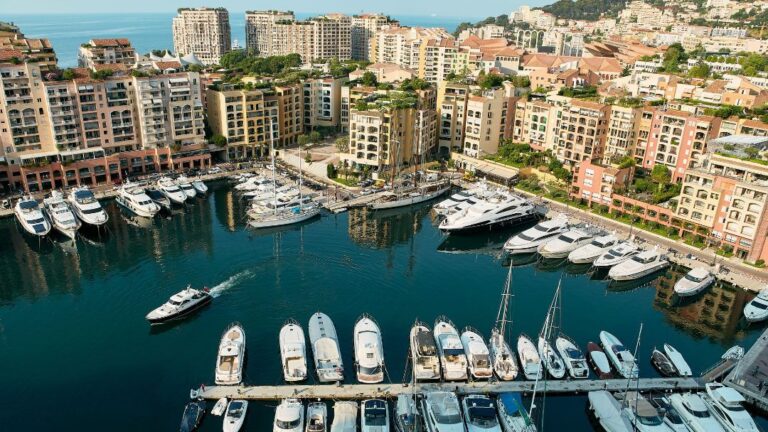
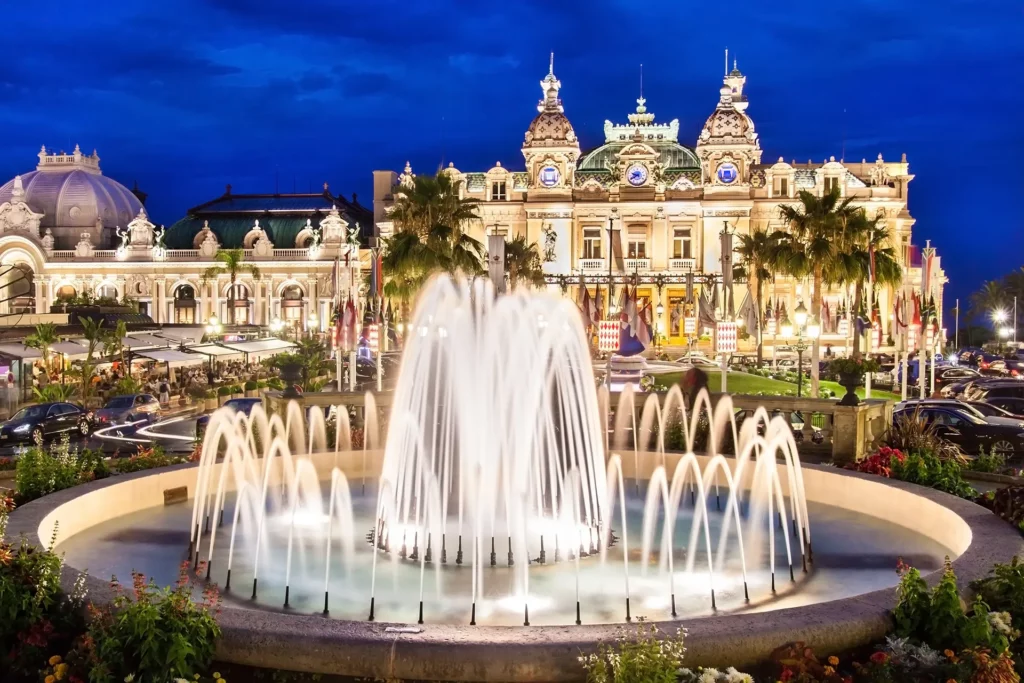
And if you want to see even more, a day trip to Monaco has plenty of surprises in store: from the Monte-Carlo Casino to Port Hercule, the Principality is brimming with treasures.
In a nutshell:
- Address: 4 Rue du Colonel-Bellando-de-Castro, on the Rock of Monaco.
- Visiting hours: 9:00 a.m. – 6:00 p.m. (except during religious services).
- Mass times: 10:30 a.m. on Sundays.
- Don’t miss: the mosaics, the altarpieces, the high altar, and the princely tombs.
Overview of St. Nicholas Cathedral in Monaco
What is the name of the cathedral in Monaco?
The cathedral in Monaco is officially named “Cathedral of Our Lady of the Immaculate Conception in Monaco.”
In common usage, however, it is more often referred to as “St. Nicholas Cathedral,” in reference to the former Saint-Nicolas Church that once stood on this site.
It is also simply referred to as “the Cathedral,” such is its central role in the Principality’s religious life and identity.
What is the history of Monaco Cathedral?
Here is a clear summary of the cathedral’s history:
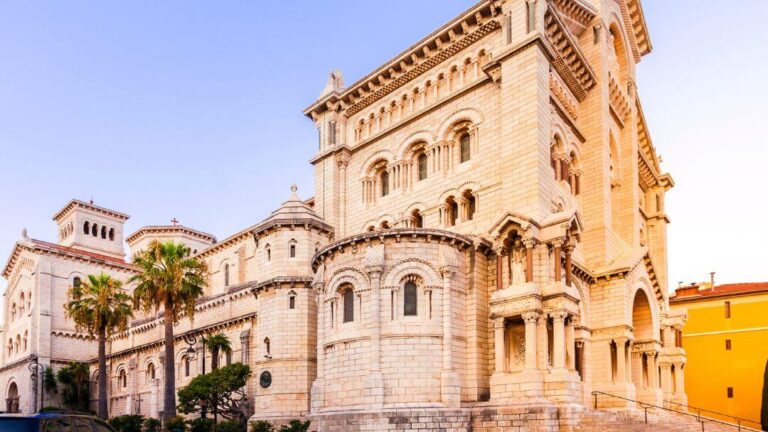
- 13th century: The Church of Saint Nicholas was built on the Rock of Monaco. It became the main place of worship for the people of Monaco.
- 1874: The church was demolished by order of Prince Charles III, who planned to build a cathedral in its place.
- 1903–1909: Construction of the current cathedral, in the Romanesque-Byzantine style, during the reign of Albert I.
- 1911: The cathedral was consecrated under the name of Our Lady of the Immaculate Conception.
- 1912: Completion of the final interior work.
How important is it to Monegasque identity?
The Cathedral of Saint Nicholas / Our Lady of the Immaculate Conception is important to Monegasque identity for several reasons:
- A spiritual and religious symbol : it is the mother church of the diocese of Monaco, the bishop’s seat, which hosts major national religious celebrations.
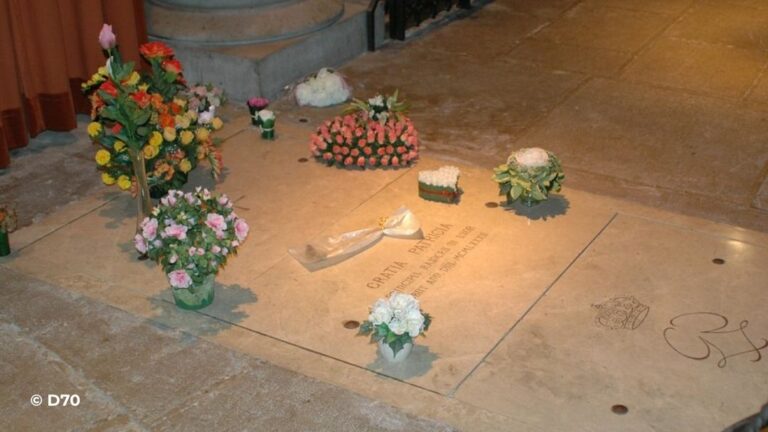
- This is the necropolis of the Princes of Monaco : it contains the tombs of many rulers, including Prince Rainier III and Princess Grace of Monaco.
- It embodies a symbolic transition between two eras in the Principality’s history: by seeking to replace a small church with a majestic cathedral, Prince Charles III is sending the message that Monaco is a sovereign state.
- Finally, the cathedral is a place of collective memory where Monegasques gather for major events.

Whether for personal or business travel, our private transfer service is at your disposal.
What You Can See in the Cathedral
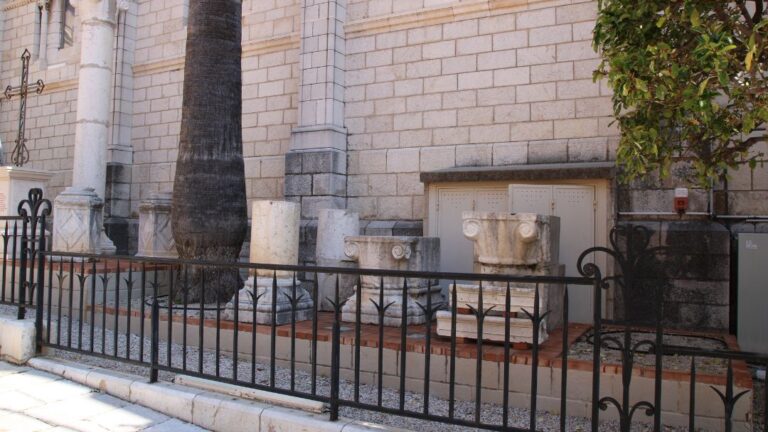
The Ruins of St. Nicholas Church
Walking along the back of the cathedral, down Rue Sainte-Barbe, you can see a few archaeological features, including pieces of capitals or columns.
The white Roman-Byzantine facade
The cathedral stands out for its imposing architecture, with a massive facade. It is approximately 22 meters wide and 18 meters tall.
Furthermore, its dazzling whiteness is due to the use of white stones from La Turbie, a local material sourced from the hilltop village just above Monaco.
Mosaics
There are indeed many remarkable mosaics inside the cathedral! Two of them caught our attention.
The contemporary mosaic dedicated to Saint Nicholas, created by artist Larissa Perekrestova, a mosaic artist of Ukrainian origin who lives in Provence. This work was a gift from the Republic of Ukraine to the Principality of Monaco.
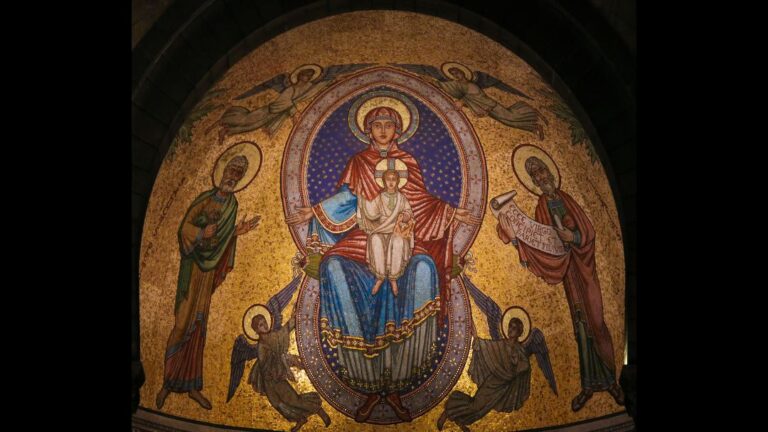
Another important mosaic features the Virgin Mary, Immaculate Conception, the cathedral’s patron saint. She points out that the building, although sometimes called “St. Nicholas Cathedral,” is officially dedicated to Our Lady of the Immaculate Conception.
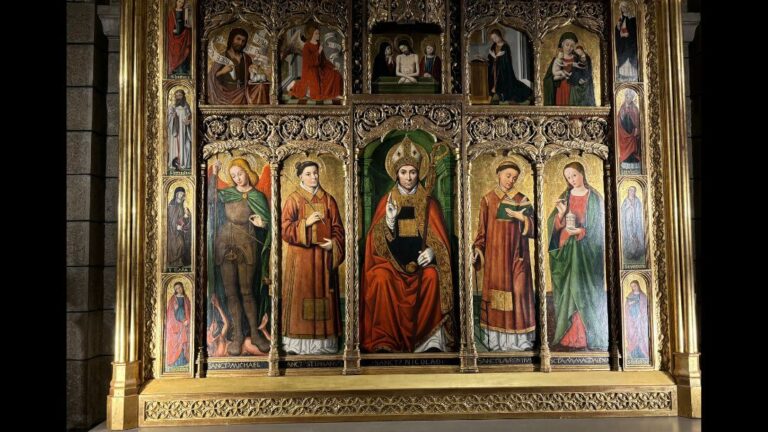
Altarpieces
These ornate vertical structures, located behind the altar table, are truly sublime.
Several can be seen in the cathedral, including the altarpiece of Saint Nicholas, created by Louis Bréa, and thealtarpiece *La Pietà des Pénitents Blancs*, created by François Bréa.
The Stained-Glass Windows
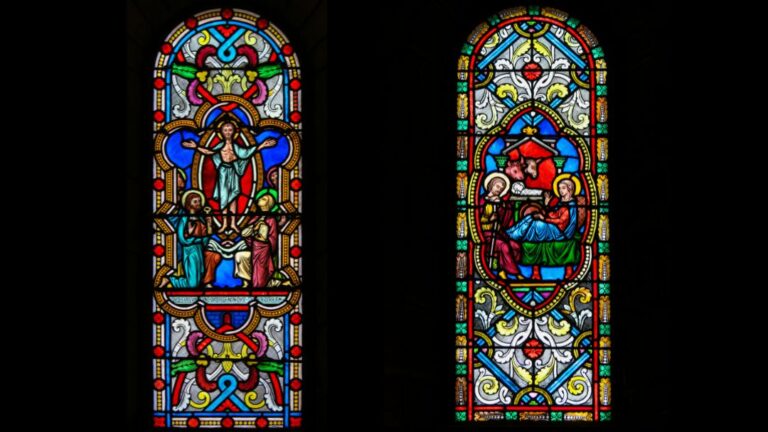
The cathedral’s stained-glass windows, also designed in the Roman-Byzantine style, bathe the interior in soft, colorful light.
💡Tour Azur’s tip: Don’t miss the beautiful Nativity scene.
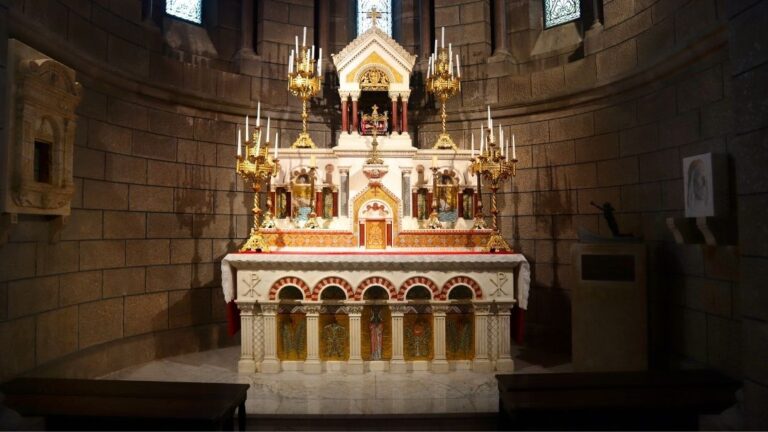
The high altar and the bishop's throne, made of white Carrara marble
In a cathedral, the term “high altar” refers to the main altar, located at the heart of the liturgical choir. This altar is particularly beautiful, inlaid with mosaics and copper.
As for the throne, it is the seat reserved for the bishop in his cathedral.
The Organs
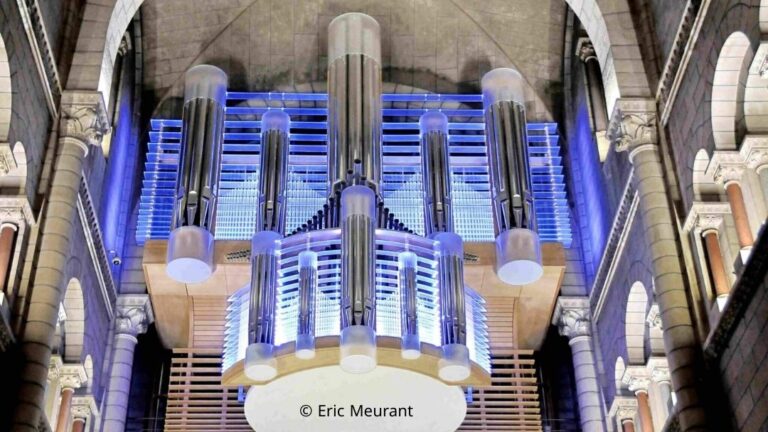
Monaco Cathedral has two impressive organs that contribute to the solemn atmosphere of the services:
- The gallery organ, also known as the “main organ,” was first installed in 1976 and overlooks the nave from the gallery. It is the main instrument used for major celebrations and concerts. It was rebuilt and expanded in 2011 and is one of a kind: thanks to Plexiglas panels illuminated by LEDs, it changes color depending on the notes played by the organist.
- The choir organ, built in 1976 by the Italian firm Giovanni Tamburini, provides more direct accompaniment for liturgical chants and daily services.
Royal Burials: Rainier III and Princess Grace of Monaco
Monaco Cathedral also serves as the burial place of the Princes of Monaco. In the ambulatory, visitors can see the tombs of several members of the princely family, the most famous of which are those of Prince Rainier III and his wife, Princess Grace.
The Petits Chanteurs de Monaco Choir
The Monaco Cathedral Choir, better known as the Petits Chanteurs de Monaco, provides the musical program for the cathedral. They can be heard singing during services, particularly the Sunday morning from September through June.
In addition to its activities in Monaco, this choir also serves as a cultural ambassador for the Principality: every summer, the Maîtrise embarks on an international tour.
👉 You can find their dates here.
Practical Information for Your Visit to Monaco Cathedral
Hours, Admission Prices, and Tour Duration
The cathedral is open to visitors every day from 9 a.m. to 6 p.m., except during religious services. Admission is free.
The tour route generally follows a recommended route : visitors enter on the right, walk around the building along the ambulatory, and then exit on the left.
Allow about 30 minutes for a self-guided tour, a little longer if you’d like to admire the artistic details or pay your respects at the princely tombs.
💡 Our tip: The cathedral, located in the very touristy Rocher neighborhood, is one of Monaco’s most visited landmarks. It gets particularly crowded in the summer. For a more peaceful visit, go in the morning and avoid weekends if possible.
Access by car, public transportation, and on foot
By bus
The cathedral is served by the bus lines 1 and 2 (Monaco-Ville – Le Rocher stop) as well as by line X1 (Le Rocher stop). From there, you’ll need to walk about 300 meters to reach the building.
👉 To view routes and schedules: www.cam.mc
By car
Access to the Rock is strictly limited to vehicles registered in Monaco or the Alpes-Maritimes department. Therefore, there is no parking available in the immediate vicinity. Visitors must park in one of the parking lots located below and then make their way to the Rock on foot or by bus.
Among the closest are:
- La Colle Parking Lot
- Place d’Armes Parking Lot
- Quai Antoine Ier Parking Lot
- La Condamine Parking Lot
👉 Rates and availability: www.parkings.mc
On foot
You can also reach the cathedral by walking up to the Rock. It’s a pleasant walk, but be warned: it’s a steep climb!

Our chauffeur-driven car service is ideal for planning your personalized itinerary.
What is there to do near the cathedral?
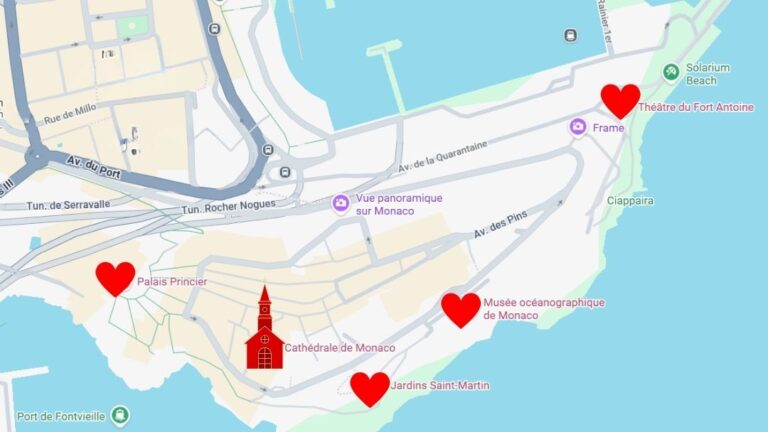
On the Rock, we recommend four places.
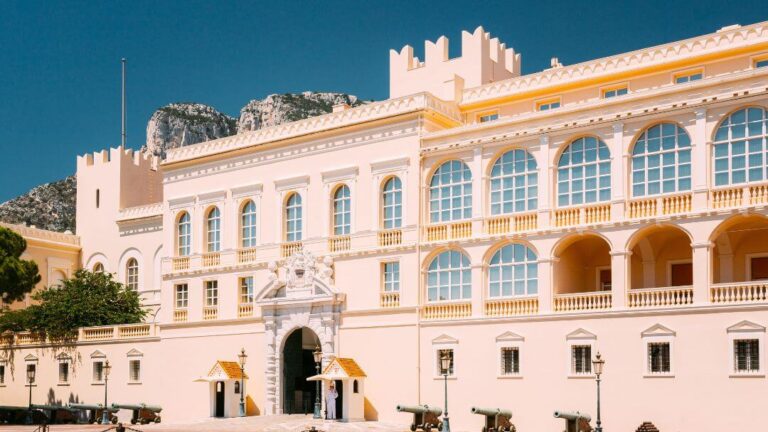
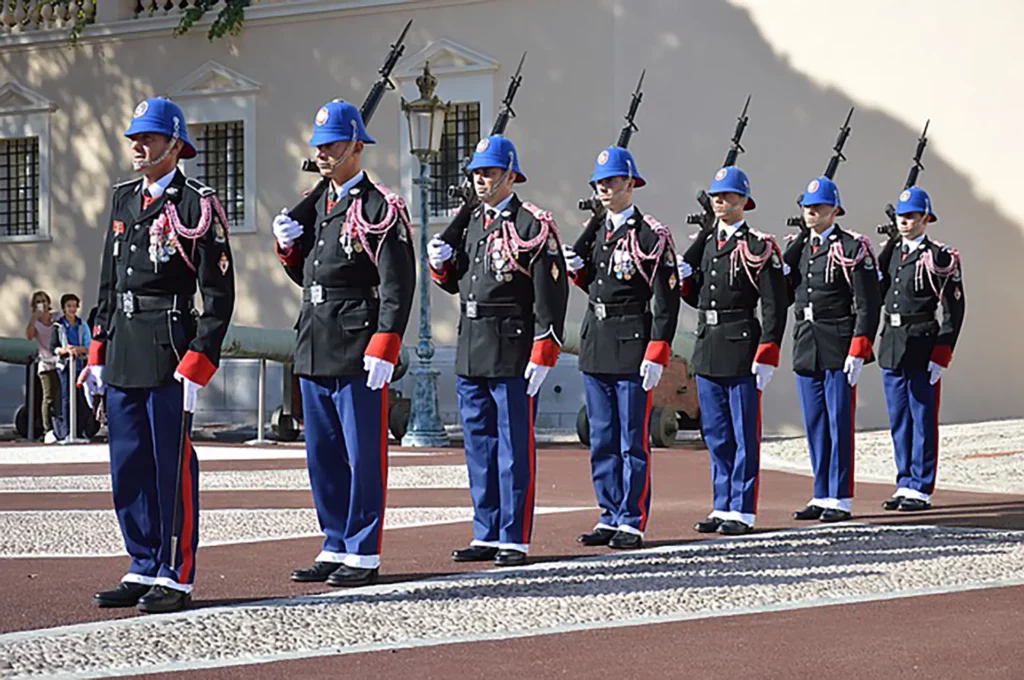
First, the Princely Palace, located just a few steps from the cathedral. It is the official residence of the Grimaldi family, and part of it is open to visitors: the richly decorated State Apartments are open to the public for part of the year. Don’t miss the changing of the guard ceremony, held daily at 11:55 a.m., which attracts many visitors.
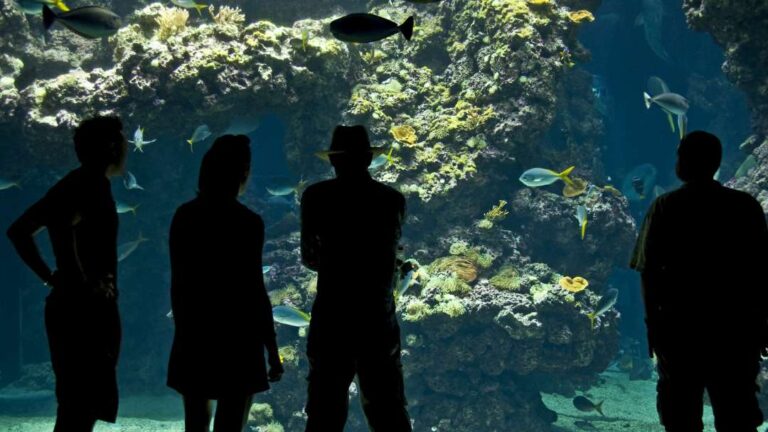
Next, the Oceanographic Museum is a world-renowned institution. Inside: spectacular aquariums, scientific collections, and interactive exhibits.
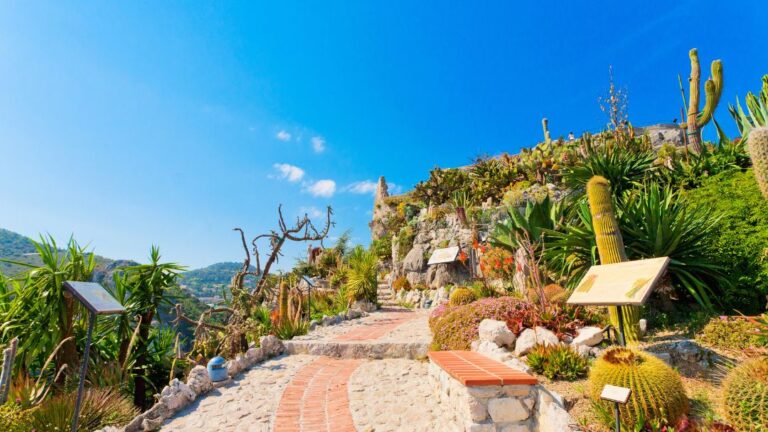
Don’t miss the Saint-Martin Gardens, which stretch out below the cathedral. These peaceful Mediterranean gardens, laid out in the 19th century, offer a superb view of the sea and shaded paths lined with exotic plants. Unlike other sites such as the exotic garden; they are much less crowded, making them an ideal spot for a quiet break before or after visiting the cathedral.
Finally, the Théâtre du Fort Antoine is A former military fortress that has been converted into a charming outdoor theater. Every summer, this venue hosts a diverse lineup that combines theater, concerts, and live performances.
Religious and Liturgical Life at the Cathedral
Mass and Service Schedules
The Cathedral of Our Lady of the Immaculate Conception is, above all, a vibrant place of worship. On Sundays, the Solemn High Mass is held at 10:30 a.m. in the cathedral, often accompanied by the Maîtrise des Petits Chanteurs de Monaco.
👉 To find out the schedule service schedule, we recommend visiting the cathedral’s official website.
Who are the bishops of Monaco?
Strictly speaking, the Principality has only one bishop: Monsignor Dominique-Marie David, who has been Archbishop of Monaco since 2020 and is a member of the Emmanuel Community.
But the cathedral’s operations also depend on a team of priests and leaders who assist it on a daily basis:
- Canon Daniel Deltreuil, archdeacon and pastor of the cathedral,
- Father Luca Favretto, assistant pastor of the parish,
- Father Pierre-Emmanuel Pauchet, on pastoral duty.
Who is the parish priest of Monaco Cathedral?
There are indeed parish priests in Monaco, just as there are in any Catholic parish. The parish priest is the priest appointed by the bishop (in this case, the archbishop of Monaco) to be in charge of a parish.
Monaco has several parishes (the Cathedral, Sainte-Dévote, Saint-Charles, Saint-Nicolas de Fontvieille, Saint-Martin/Sacré-Cœur, etc.).
Each parish therefore has its own pastor, and at Monaco Cathedral, the pastor is currently Canon Daniel Deltreuil (who is also the archdeacon).
Plan your visit to Monaco Cathedral with Tour Azur
Our private tours to explore Monaco
First, we organize private tours, fully customizable guided tours. In a private vehicle (maximum 8 people), our driver-guide will accompany you to each location for a guided tour.
Our Group Tours
Tour Azur also offers shared tours, that is, tours with a predefined route during which other customers join you in a vehicle that seats up to 8 people. The driver takes you to the various stops on your itinerary, without providing a guided tour.
Who is buried in Monaco Cathedral?
There are the tombs of most of the rulers of the Grimaldi dynasty since the early 20th century, as well as those of several princesses. Among the best-known burial sites are:
- Prince Rainier III (1923–2005), who reigned over Monaco from 1949 to 2005.
- The Princess Grace of Monaco (Grace Kelly, 1929–1982), his wife, a Hollywood actress who became a Monegasque icon.
- Prince Louis II (1870–1949), Rainier III’s grandfather.
- Prince Charles III (1818–1889), founder of modern Monte Carlo.
- Princess Charlotte (1898–1977), mother of Rainier III.
Are the cathedral and St. Nicholas Church the same thing?
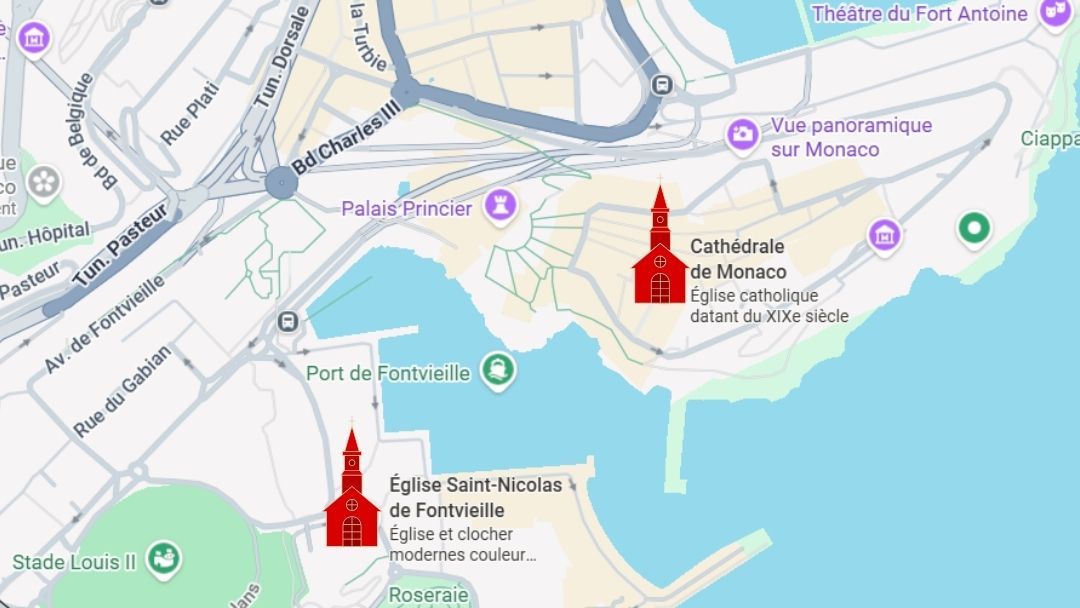
No. The confusion stems from the fact that the current Cathedral of Notre-Dame-Immaculée in Monaco was built on the site of the former Church of Saint-Nicolas, which was demolished in 1874. Hence its common name, “Saint-Nicolas Cathedral.”
But there is also, today, a Saint-Nicolas Church, located in the Fontvieille neighborhood. It was commissioned by Prince Rainier III and consecrated in 1989. It is the archdiocese’s newest parish.
Where can I find the Diocese of Monaco's program?
To stay informed about celebrations, services, and spiritual and cultural events organized by the diocese, the official website of the Diocese of Monaco features a section dedicated to events, where updated schedules are regularly posted, such as the festivities for Sainte-Dévote or other parish initiatives.
What to See in Monaco?
There’s no shortage of choices:
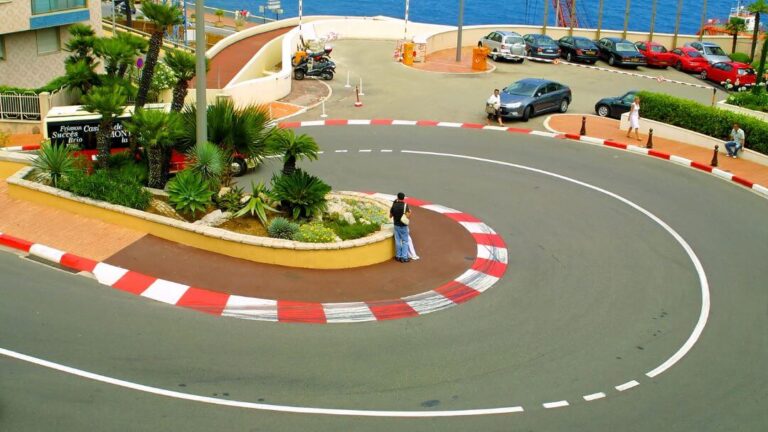
- The Formula 1 , which sets the hearts of motorsports enthusiasts racing.
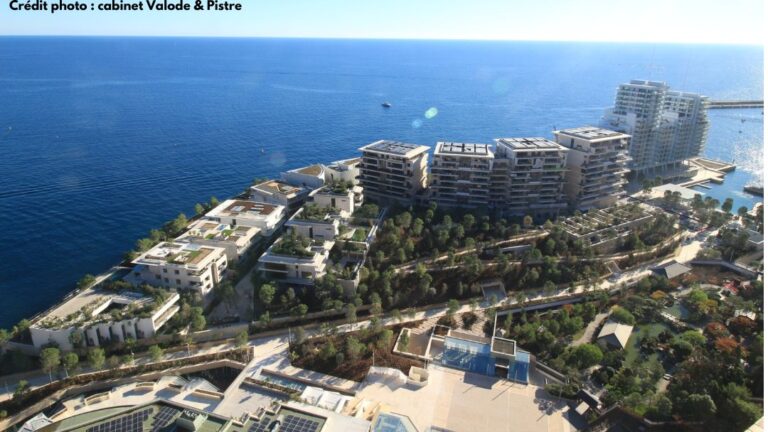
- The New Neighborhood Mareterraneighborhood is a showcase for sustainable urban planning in Monaco.
- The Automobile Museum, which showcases the Prince of Monaco’s exceptional collection.
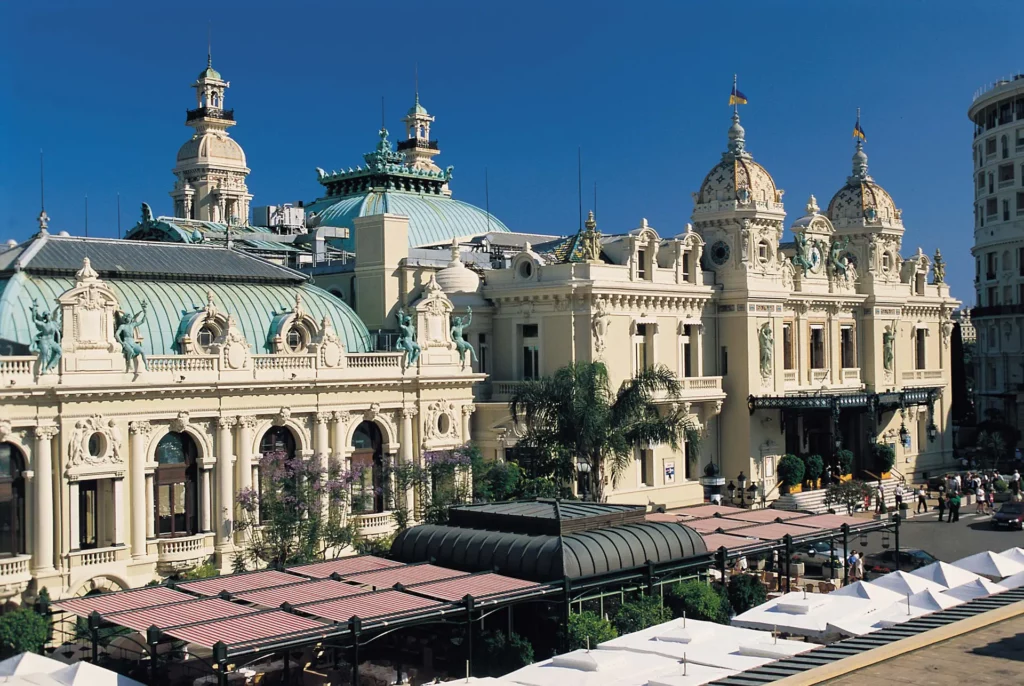
- The famous Monte Carlo Casino.
👉 For more information, we’ve written here and here comprehensive articles on the Principality’s must-see attractions and the best times to visit Monaco.